Spectacles in Children: FAQs Every Parent Should Know | Dr. Manisha Mishra
Spectacles in Children: FAQs Every Parent Should Know | Dr. Manisha Mishra
Spectacles in Children: Frequently Asked Questions
By Dr. Manisha Mishra
Senior Complex Cataract Surgeon, Squint Surgeon & Pediatric Ophthalmologist
When a child is prescribed spectacles, parents often have many questions: Will my child have to wear glasses forever? Will glasses make the eyes weaker? Is it okay if my child doesn't wear them all the time? Can the number reduce?
These are very common concerns. The important thing to understand is that spectacles in children are not simply about making vision clearer—they can be essential for the normal development of vision.
Here are some of the most frequently asked questions parents have about children's spectacles.
1. Why does my child need spectacles?
Children may need spectacles because of myopia (short-sightedness), hypermetropia (long-sightedness), astigmatism, or a difference in power between the two eyes.
Sometimes spectacles are also prescribed for children with squint or lazy eye (amblyopia). In these situations, spectacles may play an important role in allowing both eyes to develop good vision.
2. My child can see well. Why are spectacles necessary?
A child may appear to see normally even when there is a significant difference in the power of the two eyes.
For example, if one eye has a much higher power than the other, the child may simply rely on the better eye. Parents may not notice anything unusual.
If such problems are not detected and treated at the appropriate age, the weaker eye may fail to develop normal vision, resulting in amblyopia or lazy eye.
3. Will wearing spectacles make my child's eyes weaker?
No. This is one of the most common myths.
Spectacles do not make the eyes dependent on them or weaken the eyes. They simply help the eye focus light correctly.
In fact, in some children, not wearing the prescribed spectacles can interfere with normal visual development.
4. Does my child have to wear spectacles all day?
It depends on why the spectacles have been prescribed.
Some children need them throughout the day, while in others they may be recommended for particular activities. Children with amblyopia, significant refractive error, or certain types of squint may need to wear their glasses very regularly.
Follow the wearing schedule advised by your ophthalmologist rather than deciding based only on how clearly your child says they can see.
5. My child doesn't want to wear spectacles. What should I do?
Don't make spectacles feel like a punishment.
Choose a comfortable, properly fitting frame and encourage your child positively. Parents can also help by treating spectacles as something normal and positive.
Most children gradually adapt to wearing them. If your child continues to refuse them, the prescription and fit should be reassessed by the eye doctor.
6. Can my child's spectacle number increase?
Yes. Myopia, in particular, can increase during childhood and adolescence.
Therefore, children who have been prescribed spectacles should have their eyes reviewed as advised by their ophthalmologist. If the prescription changes, the spectacles may need to be updated.
7. Can the spectacle number decrease?
Sometimes the prescription can change as the child's eyes grow and develop. However, there is no single rule that applies to every child.
The reason for the prescription, the child's age, the type and amount of refractive error, and the overall eye condition all matter.
So, don't stop spectacles simply because you hope the number will reduce.
8. Does my child need eye drops before checking the spectacle number?
Often, yes—especially in younger children.
Children have a strong ability to focus their eyes, which can affect the measurement of their actual refractive error. Eye drops can temporarily relax this focusing mechanism and allow the ophthalmologist to obtain a more accurate prescription.
This is called cycloplegic refraction and is particularly important when assessing young children.
9. Can an optical shop determine my child's spectacle power?
A spectacle prescription should ideally be based on a proper eye examination by an eye-care professional, particularly in young children.
A complete pediatric eye examination may include vision assessment, examination of eye alignment and eye health, and objective refraction. Automated screening devices can be useful for screening, but they do not replace a complete examination when a child needs further evaluation.
10. What if only one eye has a high spectacle number?
This is particularly important.
A large difference in power between the two eyes is called anisometropia. Children may not complain because the better eye can compensate for the weaker one.
If untreated, the weaker eye may develop amblyopia. Therefore, such children often need careful follow-up and appropriate spectacle wear.
11. What type of spectacle frame should I choose for my child?
Comfort and proper fitting are more important than fashion alone.
The frame should:
Fit comfortably without being too tight.
Not slide down the nose constantly.
Keep the eyes properly centred behind the lenses.
Be appropriate for the child's age and activities.
Be sturdy enough for everyday use.
A poorly fitting frame can make it difficult for a child to wear spectacles consistently.
12. Which spectacle lenses are suitable for children?
Children's lenses should be chosen with safety and durability in mind. Polycarbonate lenses are commonly recommended for children because they are lightweight and impact-resistant.
The exact lens material, coatings and design should be selected according to the child's age, prescription and activities.
13. Can my child play sports while wearing spectacles?
Yes. Children can remain active while wearing spectacles.
For children involved in contact or high-impact sports, appropriate protective eyewear should be considered. Prescription sports eyewear may also be useful for some activities.
14. Should my child wear spectacles while using a computer or mobile phone?
If spectacles have been prescribed, they should be used according to the ophthalmologist's instructions.
However, spectacles alone do not prevent myopia progression. Healthy visual habits—including spending time outdoors and taking regular breaks during prolonged near work—are also important parts of children's eye care.
15. How often should my child's eyes be checked?
The appropriate interval depends on the child's age, spectacle power, eye condition and whether the prescription is changing.
Children who already wear spectacles should have regular follow-up as advised by their ophthalmologist, rather than waiting until they complain that they cannot see.
Routine vision screening is also important during childhood because many children do not recognise or report that their vision is abnormal.
16. What signs suggest that my child may need an eye examination?
Watch for signs such as:
Sitting very close to the television
Holding books or mobile devices very close
Squinting to see distant objects
Frequent headaches or eye strain
Difficulty seeing the blackboard
Closing one eye while looking at something
Frequent blinking or rubbing of the eyes
An eye turning in or out
Poor performance or difficulty concentrating at school
However, absence of symptoms does not necessarily mean that a child's vision is normal. Some children with significant differences between their eyes may not complain at all.
A Message for Parents
Spectacles are not a weakness. They are a tool that helps your child's vision develop normally.
If your child has been prescribed spectacles, don't stop them because the child says, “I can see without them.” The purpose of spectacles in children is sometimes much more than simply improving today's vision—it may be about protecting the child's visual development for the future.
A timely eye examination and the correct spectacle prescription can make a significant difference during the crucial years of visual development.
If you have concerns about your child's vision, spectacle number, squint, or difficulty wearing glasses, consult a pediatric ophthalmologist for an appropriate examination.
Dr. Manisha Mishra
Senior Complex Cataract Surgeon, Squint Surgeon & Pediatric Ophthalmologist
Shantanu Netralaya Eye Hospital, Varanasi
This article is for patient education. It is not a substitute for personalised medical advice, examination or diagnosis. If you have symptoms discussed here, please book an in-person consultation with a qualified ophthalmologist.
Dr. Shantanu personally reviews every enquiry — usually within a few hours.
Message on WhatsApp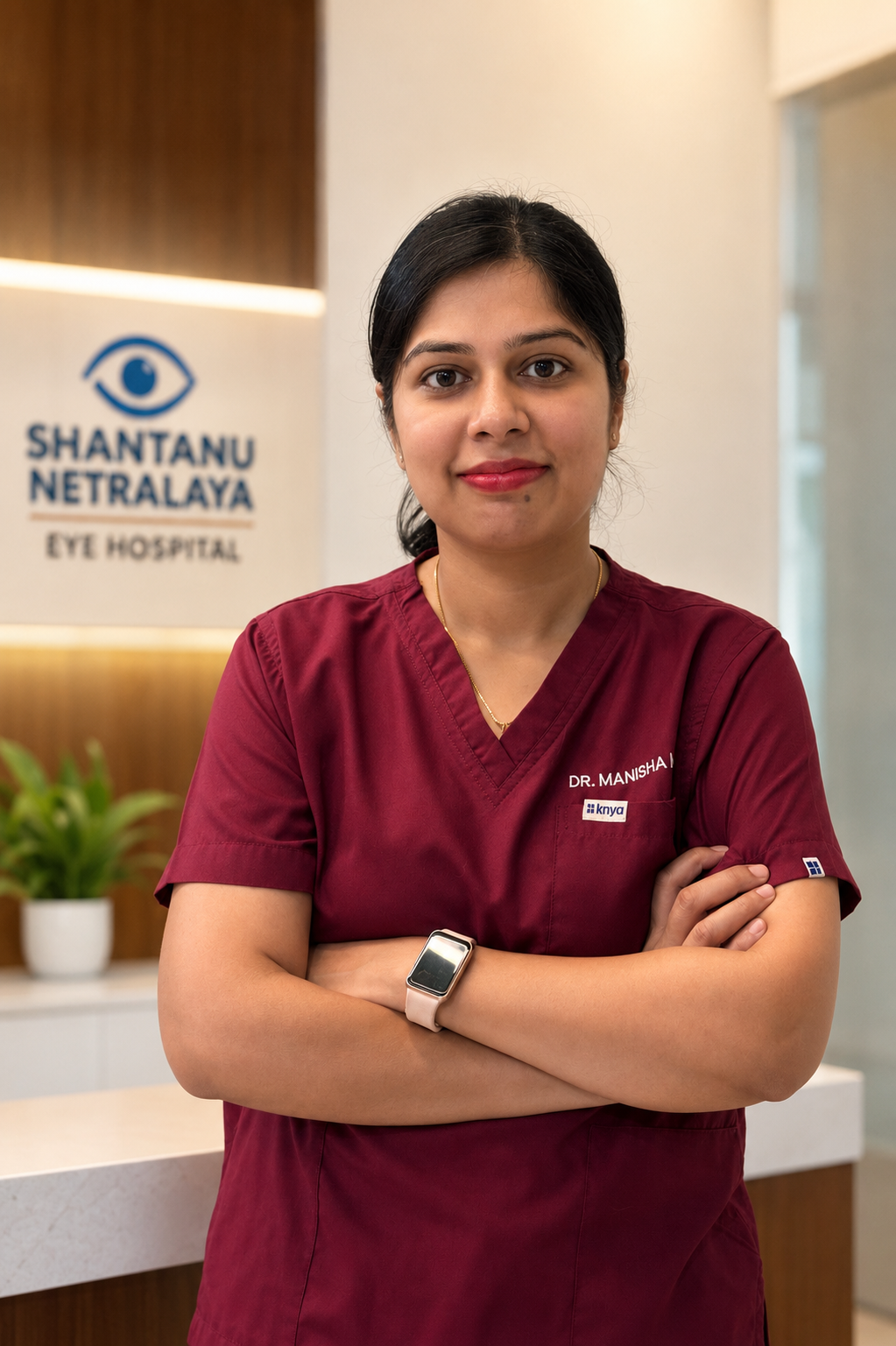
Consultant Ophthalmologist at Shantanu Netralaya Eye Hospital, Varanasi. MBBS Gold Medalist with 4 distinctions; MS Ophthalmology from Maulana Azad Medical College & Guru Nanak Eye Centre, New Delhi. Handles complex cataract, squint (strabismus) and paediatric ophthalmology.