Complex Cataract Surgeon in Varanasi | Dr. Manisha Mishra
Looking for a cataract surgeon in Varanasi for routine or complex cases? Learn about Dr. Manisha Mishra’s approach to advanced cataract care at Shantanu Netralaya.
Dr. Manisha Mishra: Advanced Cataract Surgery in Varanasi for Routine and Complex Cataract Cases
By Dr. Manisha Mishra
Senior Cataract Surgeon, Squint Surgeon & Pediatric Ophthalmologist
Shantanu Netralaya Eye Hospital, Varanasi
Cataract surgery is one of the most commonly performed eye surgeries today. For many patients, it is a straightforward procedure with excellent visual outcomes. But not every cataract is a routine cataract.
Some patients present with very dense or mature cataracts. Others may have a small pupil, weak or damaged supporting structures of the natural lens, previous eye surgery, trauma, glaucoma, corneal problems, high refractive errors or other associated eye conditions. In such situations, cataract surgery requires considerably more than simply removing an opaque lens.
This is where the experience and surgical judgement of the ophthalmologist become particularly important.
Dr. Manisha Mishra at Shantanu Netralaya, Varanasi, provides cataract care ranging from routine cataract surgery to the assessment and management of challenging and complex cataract situations.
Why is every cataract not the same?
A cataract is a clouding of the natural lens of the eye. However, the surgical difficulty can vary considerably from patient to patient.
A relatively soft cataract with a healthy cornea, normal pupil and stable lens-supporting structures may be comparatively straightforward.
On the other hand, a patient may present with:
Very hard or mature cataract
White or intumescent cataract
Small or poorly dilating pupil
Weak zonules or unstable lens-supporting structures
Subluxated or partially displaced lens
Previous eye surgery
Cataract following eye trauma
Cataract associated with glaucoma
Cataract in an eye with corneal disease
Cataract in patients with multiple previous ocular problems
Cataract in younger or pediatric patients
These situations require careful preoperative assessment and individualized surgical planning.
What makes a cataract surgeon suitable for complex cases?
Complex cataract surgery is not simply about having advanced equipment.
It requires the ability to recognize potential problems before surgery, anticipate what may happen during surgery and modify the surgical plan when necessary.
A comprehensive cataract evaluation may involve assessment of:
Corneal health
Tear film and ocular surface
Pupil size and dilation
Lens density and morphology
Zonular stability
Anterior chamber anatomy
Retina and macula
Optic nerve
Previous surgical history
Refractive status
Patient expectations
This is particularly important because a cataract may not be the only reason a patient's vision is reduced.
Dr. Manisha Mishra's approach to cataract surgery in Varanasi
Dr. Manisha Mishra practices at Shantanu Netralaya Eye Hospital in Varanasi, where her clinical areas include cataract surgery along with pediatric ophthalmology and squint management. Her formal ophthalmology training includes MS Ophthalmology from Maulana Azad Medical College, Delhi.
Her approach to cataract care is based on an important principle:
The goal is not simply to remove the cataract. The goal is to understand the patient's eye and choose the safest and most appropriate surgical plan for that particular eye.
This distinction becomes especially important in complicated cataract cases.
Complex cataracts require careful planning
1. Mature and very hard cataracts
A very dense cataract can be more challenging to manage than an early or moderate cataract.
In these cases, the surgeon needs to plan the operation carefully and consider factors such as the density of the lens, the condition of the cornea, pupil behavior and the stability of the lens.
2. White or intumescent cataracts
White cataracts can present additional surgical challenges because the normal landmarks visible through a clear or partially opaque lens may be difficult to identify.
Careful surgical planning is particularly important in these cases.
3. Small pupil cataract surgery
Some patients do not dilate adequately even after appropriate medication.
A small pupil can make visualization and surgical manipulation more difficult. The surgeon may therefore need to modify the surgical approach depending on the individual eye.
4. Weak zonules or unstable lens
The natural lens is held in position by fine supporting fibers called zonules.
When these structures are weak or damaged, the cataract can become more challenging to remove and the intraocular lens may require additional support or a different surgical strategy.
This can occur with conditions such as pseudoexfoliation, previous trauma, previous surgery or other structural abnormalities.
5. Traumatic cataracts
Cataracts following an eye injury can be very different from age-related cataracts.
Trauma may affect not only the lens but also the iris, zonules, cornea, retina or other structures of the eye.
Such patients need a comprehensive assessment rather than treating the cataract in isolation.
Cataract surgery in children is a completely different field
One of Dr. Manisha Mishra's important areas of practice is pediatric ophthalmology and squint management. Her clinical profile specifically lists pediatric eye care along with cataract and squint services.
Cataract in a child requires a very different approach from age-related cataract in an elderly patient.
A child's visual system is still developing. Therefore, simply removing the cloudy lens is not the complete treatment.
The ophthalmologist may also need to consider:
Accurate assessment of visual development
Amblyopia
Appropriate optical correction
Intraocular lens selection
Binocular vision
Associated squint
Long-term follow-up
This is one reason why families looking for cataract treatment for a child should seek an ophthalmologist experienced in pediatric eye care rather than assuming that all cataract surgery is the same.
Cataract surgery when other eye problems are present
Many patients in Varanasi and Purvanchal have more than one eye condition.
For example, a patient with cataract may also have:
Glaucoma
Diabetic eye disease
Previous retinal disease
Corneal problems
High myopia
Previous ocular trauma
Previous eye surgery
Squint or abnormal eye movements
In these patients, cataract surgery needs to be planned in the context of the whole eye, not just the cloudy lens.
This comprehensive approach is particularly valuable because removing a cataract cannot reverse damage caused by diseases of the retina, optic nerve or cornea.
Does complex cataract surgery always mean a bigger operation?
Not necessarily.
“Complex cataract” describes the clinical situation, not necessarily the size of the incision or the length of the operation.
Modern cataract surgery techniques allow many challenging cataracts to be managed through small-incision approaches. However, the exact technique depends on the patient's anatomy and the surgeon's assessment.
The safest approach is not to promise a particular technique before examining the eye.
Choosing the right intraocular lens
Cataract surgery also involves an important second decision: choosing the appropriate intraocular lens (IOL).
There is no single “best lens” for every patient.
The choice may depend on:
Corneal measurements
Eye length
Astigmatism
Retinal health
Glaucoma or other eye disease
Previous surgery
Lifestyle
Reading and distance-vision requirements
Night-driving needs
Budget and expectations
A premium lens may be excellent for one patient but inappropriate for another.
This is why IOL selection should follow a detailed assessment of the patient's eye and visual needs rather than being based simply on lens price or marketing claims.
Why patients from Purvanchal may benefit from specialist cataract evaluation in Varanasi
Varanasi is an important medical centre for patients from across Eastern Uttar Pradesh.
Patients travel to Varanasi from areas including Chandauli, Ghazipur, Jaunpur, Mirzapur, Bhadohi, Sonbhadra, Azamgarh and surrounding districts for specialist eye care.
For patients travelling from outside the city, the most important consideration should not simply be finding the closest cataract centre.
It should be finding a surgeon who can:
Diagnose the cataract accurately.
Identify associated eye disease.
Recognize whether the case is routine or complex.
Explain the available surgical options.
Select an appropriate IOL.
Discuss realistic visual expectations.
Provide appropriate postoperative follow-up.
When should you seek a second opinion before cataract surgery?
A second opinion can be particularly useful when:
You have been told that your cataract is very complicated.
The pupil does not dilate adequately.
You have been told that the lens is unstable.
You have had previous eye surgery or trauma.
You have glaucoma or retinal disease.
You have significant corneal disease.
The cataract developed at an unusually young age.
You have already undergone unsuccessful cataract surgery in the other eye.
You are unsure about which IOL is appropriate.
Different surgeons have given you different recommendations.
A second opinion is not a sign of distrust. For a major decision involving vision, understanding your options is reasonable.
What should you expect during your cataract consultation?
A good cataract consultation should answer more than the question:
“Do I have cataract?”
It should also answer:
How advanced is the cataract?
Is the cataract responsible for the reduction in vision?
Is there any retinal or optic nerve disease?
Is the cornea healthy?
Is the pupil adequate?
Are the lens-supporting structures stable?
What type of surgery is appropriate?
What IOL options are suitable?
What vision can realistically be expected after surgery?
Are there additional risks because this is a complex case?
These questions become even more important when the cataract is not routine.
A surgeon for routine cataracts—and a surgeon to consider when the case is difficult
Most cataract patients want a safe, predictable operation. That is entirely reasonable.
But when the anatomy of the eye is unusual or multiple eye conditions are present, the surgeon's ability to adapt becomes particularly important.
Dr. Manisha Mishra combines cataract surgery with expertise in pediatric ophthalmology and squint care, providing a broader clinical perspective when evaluating patients whose cataract may not fit the usual pattern. Her practice at Shantanu Netralaya includes advanced cataract care as well as pediatric and squint services.
For patients in Varanasi and Purvanchal looking for cataract evaluation, the key is not simply asking:
“Who performs the most cataract surgeries?”
A better question is:
“Who can understand my particular eye and choose the safest surgical plan for me?”
Conclusion
Cataract surgery is highly successful in the majority of appropriately selected patients, but cataract cases are not all equal.
Routine cataracts may be relatively straightforward. Dense, mature, traumatic, pediatric or anatomically complicated cataracts can require significantly more careful planning.
For patients in Varanasi and Purvanchal, Dr. Manisha Mishra at Shantanu Netralaya provides cataract care with an emphasis on individualized assessment, appropriate IOL selection and management of patients who may have additional ocular challenges.
If you or a family member has been told that the cataract is “complicated,” “very hard,” “mature,” “unstable,” or associated with another eye problem, a specialist cataract evaluation can help you understand the situation and your treatment options.
Your cataract may be routine—or it may not be. The difference is worth understanding before surgery.
About Dr. Manisha Mishra
Dr. Manisha Mishra is an ophthalmologist practicing at Shantanu Netralaya Eye Hospital, Varanasi. Her clinical practice includes cataract surgery, squint surgery and pediatric ophthalmology. She completed her ophthalmology training at Maulana Azad Medical College, New Delhi, and provides comprehensive eye care for patients in Varanasi and the wider Purvanchal region.
Shantanu Netralaya Eye Hospital
Varanasi, Uttar Pradesh
Cataract • Pediatric Ophthalmology • Squint • Comprehensive Eye Care
This article is for patient education. It is not a substitute for personalised medical advice, examination or diagnosis. If you have symptoms discussed here, please book an in-person consultation with a qualified ophthalmologist.
Dr. Shantanu personally reviews every enquiry — usually within a few hours.
Message on WhatsApp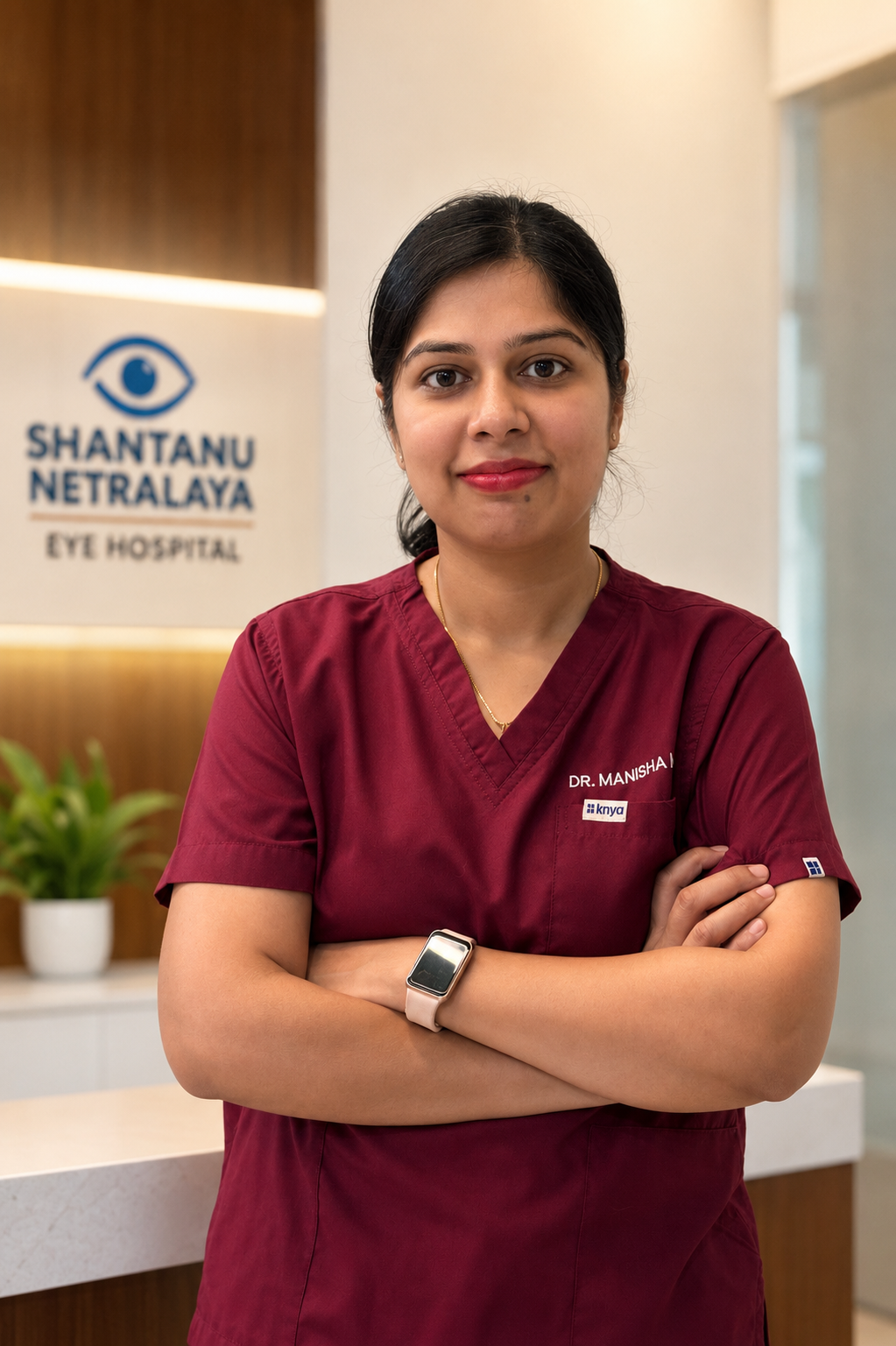
Consultant Ophthalmologist at Shantanu Netralaya Eye Hospital, Varanasi. MBBS Gold Medalist with 4 distinctions; MS Ophthalmology from Maulana Azad Medical College & Guru Nanak Eye Centre, New Delhi. Handles complex cataract, squint (strabismus) and paediatric ophthalmology.
Related articles
Which Cataract Surgery Lens Is Right for You? Try Our Free Cataract Lens Selection Tool
ReadWhich Cataract Surgery Lens Implant Is Right for You? Expert Guide | Varanasi
Readमोतियाबिंद सर्जरी के 40 सवालों के जवाब | Cataract FAQ Varanasi
ReadServices related to this article
Bladeless, stitchless cataract surgery — MAMC-trained precision, delivered in Varanasi.
When routine cataract surgery isn't enough — MAMC-trained expertise for the difficult case.
Cosmetic and functional squint correction — for children, teens and adults.