How to Choose the Best Lens (IOL) for Cataract Surgery: A Complete Patient Guide
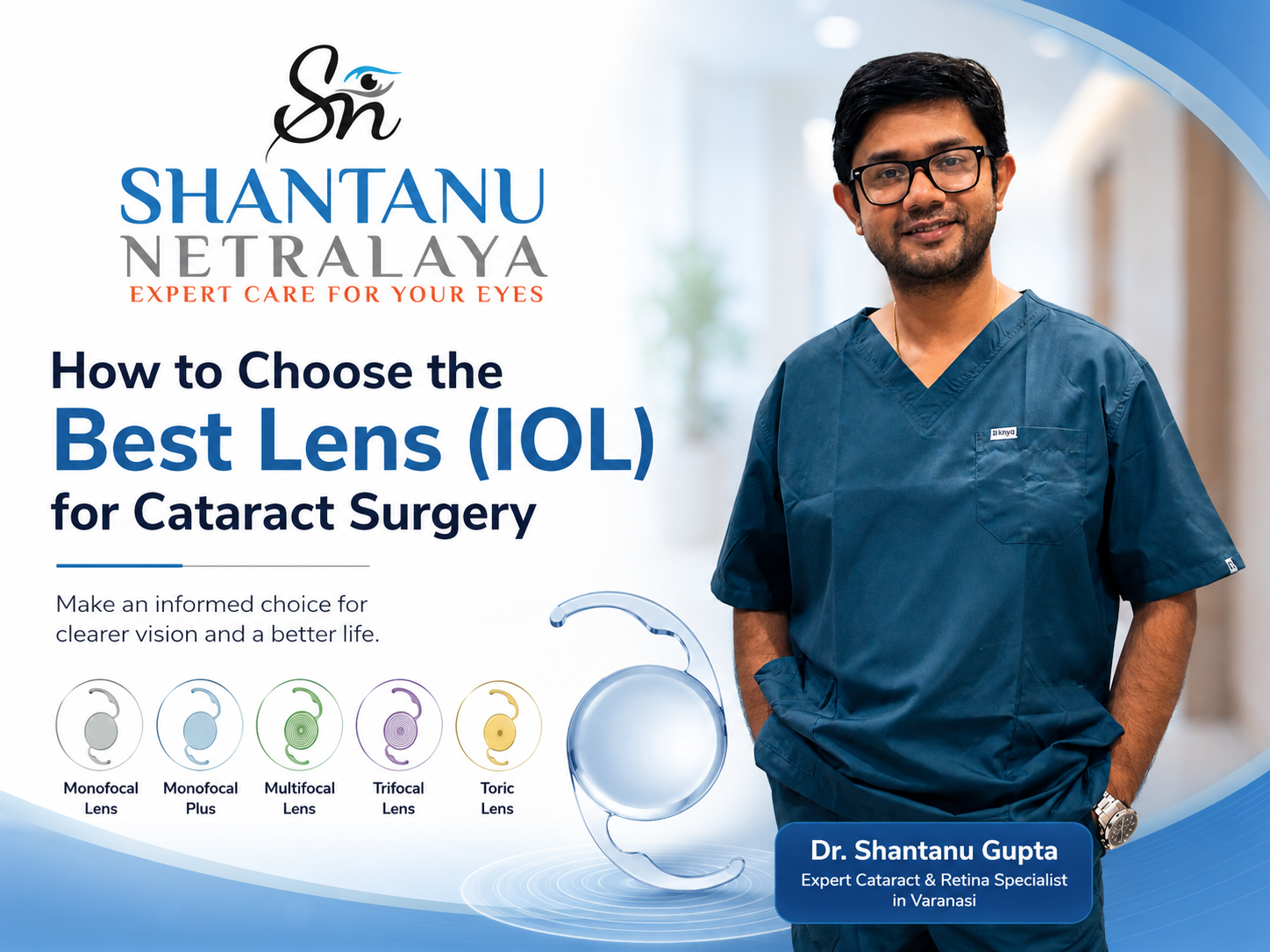
Not sure which cataract lens is right for you? Learn the differences between monofocal, premium, multifocal, trifocal, EDOF, and toric lenses, and discover how to choose the best IOL for clear, comfortable vision after cataract surgery.
# How to Choose the Best Lens (IOL) for Cataract Surgery: A Complete Patient Guide
*Cataract surgery is one of the safest and most successful operations performed today. However, one of the most important decisions you'll make before surgery isn't the surgery itself—it's choosing the right intraocular lens (IOL).*
Many patients ask me:
* Which cataract lens is the best? * Should I choose a premium lens? * Will I still need spectacles after surgery? * Is an expensive lens always better?
The truth is that there is no single "best" lens for everyone. The ideal lens depends on your lifestyle, eye health, occupation, and visual expectations.
In this guide, I'll explain the different types of cataract lenses in simple language so you can make an informed decision.
---
# What Is an Intraocular Lens (IOL)?
During cataract surgery, the cloudy natural lens is removed and replaced with an artificial clear lens called an Intraocular Lens (IOL).
Unlike glasses or contact lenses, an IOL stays inside the eye permanently and usually lasts a lifetime.
Modern IOLs are made from highly biocompatible materials and provide excellent visual quality.
---
# Why Choosing the Right Lens Matters
Think of buying a new car.
Every car can take you from one place to another, but some offer additional comfort, safety features, fuel efficiency, and convenience.
Similarly, every cataract lens restores clear vision, but different lenses provide different levels of visual freedom.
Choosing the right lens can significantly improve your quality of life for years to come.
---
# Types of Cataract Lenses
1. Monofocal Lens
A monofocal lens provides clear vision at one fixed distance.
Usually, it is set for distance vision.
This means you can comfortably see:
* Television * Driving * Walking outdoors * Watching movies
However, you will usually require reading glasses for:
* Reading books * Mobile phones * Newspapers * Sewing * Writing
### Advantages
✔ Excellent quality of vision
✔ Lowest chance of glare or halos
✔ Affordable
✔ Suitable for most patients
### Best For
* Patients comfortable using reading glasses * Elderly patients * Patients with retinal diseases * Patients with glaucoma
---
2. Monofocal Plus (Enhanced Monofocal)
These are newer-generation lenses that provide:
* Excellent distance vision * Slightly better intermediate vision * Better computer vision than standard monofocal lenses
Many patients experience greater independence from glasses for everyday activities.
### Best For
* Office workers * Computer users * Active adults * Patients wanting premium quality vision without multifocal side effects
Examples include enhanced monofocal lenses such as TECNIS Eyhance®.
---
3. Multifocal Lens
Multifocal lenses are designed to provide vision at multiple distances:
* Distance * Intermediate * Near
Many patients can perform daily activities without spectacles.
### Benefits
* Reduced dependence on glasses * Convenient for reading * Helpful for travelling * Suitable for active lifestyles
### Possible Limitations
Some patients may notice:
* Halos around lights * Night-time glare * Slight reduction in contrast sensitivity
Most patients adapt over time, but these lenses are not suitable for everyone.
---
4. Trifocal Lens
Trifocal lenses improve vision at:
* Distance * Intermediate (computer) * Near (reading)
They provide one of the highest levels of spectacle independence available today.
### Best For
* Professionals * Frequent travellers * People who enjoy reading * Patients seeking maximum convenience
---
5. Extended Depth of Focus (EDOF) Lens
EDOF lenses create a continuous range of vision rather than separate focal points.
Compared with multifocal lenses, they generally produce:
* Fewer halos * Better night vision * Excellent distance vision * Good intermediate vision * Functional near vision
These lenses are becoming increasingly popular because they balance visual quality with reduced optical side effects.
---
6. Toric Lens
If you have significant astigmatism (cylindrical power), a toric lens can correct it during cataract surgery.
Without a toric lens, many patients still require spectacles despite successful surgery.
### Benefits
* Sharper vision * Less dependence on glasses * Better visual quality
---
# Which Lens Is Best for You?
There is no universal answer.
Your ophthalmologist considers several factors before recommending a lens.
### Age
A younger, active person may have different visual needs than an elderly retiree.
### Occupation
A software engineer, teacher, driver, tailor, farmer, and surgeon all use their eyes differently.
### Daily Lifestyle
Do you:
* Read frequently? * Drive at night? * Use computers for long hours? * Travel often? * Play sports?
Your lifestyle strongly influences the ideal lens choice.
### Eye Health
Certain eye conditions can affect lens selection, including:
* Diabetic retinopathy * Glaucoma * Macular degeneration * Previous retinal surgery * Corneal diseases
In some of these conditions, premium lenses may not provide the expected benefits.
---
# Is the Most Expensive Lens Always the Best?
Not necessarily.
A premium lens is only "premium" if it suits your eye.
For example:
A patient with advanced diabetic retinal disease may achieve better vision with a high-quality monofocal lens than with an expensive multifocal lens.
The goal is not to implant the costliest lens—it is to implant the most appropriate lens.
---
# Questions to Ask Your Eye Surgeon
Before surgery, consider asking:
* Which lens do you recommend for my eyes? * Will I need glasses afterward? * Do I have astigmatism? * Am I suitable for a premium lens? * What are the advantages and disadvantages of each option? * What results can I realistically expect?
A good surgeon will explain the choices clearly and help you make an informed decision.
---
# Can I Choose Any Lens I Want?
Not always.
Sometimes medical conditions make certain lenses unsuitable.
For example:
* Severe diabetic retinopathy * Advanced glaucoma * Corneal scarring * Irregular astigmatism * Previous retinal surgery
In such cases, your surgeon may recommend a different lens that offers better visual quality and long-term outcomes.
---
# Myths About Premium Lenses
### Myth: Premium lenses guarantee perfect vision.
Fact: Vision also depends on the health of your retina, cornea, optic nerve, and overall eye condition.
---
### Myth: The most expensive lens is always the best.
Fact: The best lens is the one that matches your eyes and lifestyle.
---
### Myth: Everyone becomes completely spectacle-free.
Fact: Many patients achieve excellent independence from glasses, but some may still require spectacles for specific tasks.
---
# Final Thoughts
Choosing an intraocular lens is one of the most important decisions in your cataract surgery journey.
Rather than focusing only on the price or brand, think about:
* Your lifestyle * Your daily visual needs * Your eye health * Your long-term expectations
A detailed discussion with your cataract surgeon can help you select the lens that offers the best balance of vision, comfort, and quality of life.
Remember, the best lens isn't the most expensive one—it's the one that's best suited to your eyes.
---
Frequently Asked Questions (FAQs)
### Which is the best lens for cataract surgery?
There is no single best lens for everyone. The ideal lens depends on your eye health, lifestyle, occupation, and visual expectations.
### Will I need glasses after cataract surgery?
It depends on the type of lens implanted. Patients with monofocal lenses often need reading glasses, while premium lenses may reduce dependence on spectacles.
### Are premium lenses worth it?
For suitable candidates, premium lenses can provide greater freedom from glasses and improved convenience. However, they are not appropriate for every patient.
### Can diabetic patients receive premium lenses?
Some diabetic patients are good candidates, while others may benefit more from a monofocal lens. The decision depends on the health of the retina.
### How long does an intraocular lens last?
Modern intraocular lenses are designed to remain in the eye for life and generally do not require replacement.
About the Author
Dr. Shantanu Gupta is an Expert Cataract and Retina Specialist in Varanasi with extensive experience in advanced cataract surgery and the management of retinal diseases, including diabetic retinopathy, age-related macular degeneration (AMD), retinal vein occlusions, and retinal detachments.
He is committed to providing evidence-based, patient-centered eye care using the latest diagnostic and surgical technologies. His approach focuses on helping patients understand their eye conditions and make informed decisions about their treatment.
If you are considering cataract surgery and are unsure which intraocular lens (IOL) is best for you, a detailed eye examination and personalized consultation can help determine the most suitable option based on your lifestyle, visual needs, and overall eye health.
Dr. Shantanu Gupta practices at Shantanu Netralaya, Varanasi, where he offers comprehensive eye care services, including cataract surgery, retina treatment, diabetic eye disease management, intravitreal injections, laser procedures, and routine eye examinations.
Book a consultation today to receive expert guidance on choosing the right cataract lens and achieving the best possible visual outcome.
Treatments Dr. Shantanu offers for this
This article is for patient education. It is not a substitute for personalised medical advice, examination or diagnosis. If you have symptoms discussed here, please book an in-person consultation with a qualified ophthalmologist.
Dr. Shantanu personally reviews every enquiry — usually within a few hours.
Message on WhatsApp
Consultant Ophthalmologist at Shantanu Netralaya Eye Hospital, Varanasi. New Delhi (MAMC / Guru Nanak Eye Centre) trained cataract, cornea and medical retina specialist. FICO (Merit).
Related articles

Services related to this article
Bladeless, stitchless cataract surgery — MAMC-trained precision, delivered in Varanasi.
When routine cataract surgery isn't enough — MAMC-trained expertise for the difficult case.